

Patriarchy and the Gendered Division of Labour ft. 'Juice'
- Admin Ohana

- May 27
- 3 min read

By watching the short film ‘Juice’, the fourth session of Chaar Kadam with Smilo on May 23, 2026 intended to explore the role of gender in assigning any job to a person in the society. The session began with Smilo sharing some theoretical concepts of feminism as different approaches to analyse the film, and the society. After watching the film, the attendees, having joined from different parts of the country, contributed to a thematic discussion.
While discussing the gendered division of labour, Smilo engaged with patriarchy and illustrated it through a 1970s Bollywood song, ‘Sharm Aati Hai’ from Padosan. In his lyrics and choreography analysis, he noted that although the song initially appears normal and soothing to the ears, it is deeply rooted in patriarchal structures. While discussing gendered division of labour, Smilo touched upon patriarchy and illustrated it through a bollywood song ‘Sharm Aati Hai’ from the 70s film Padosan, which, as he said, seemed quite normal and soothing to ears at first but was deeply rooted in patriarchy. In this vein, he then discussed the theory of ‘The Second Shift’ propounded by Arlie Hochschild, invisible labour, internalised patriarchy and intersectionality of different cultural aspects influencing one’s professional life.
After this theoretical part of the session, the film was screened and a thematic discussion among the participants followed. Initially, Smilo shared his interpretation about the film; while doing so his primary focus was on difference in work spaces for men and women, normalisation of patriarchy in households, intellectual erasure of women from the mainstream professions and the intersectionality of gender, caste and class.
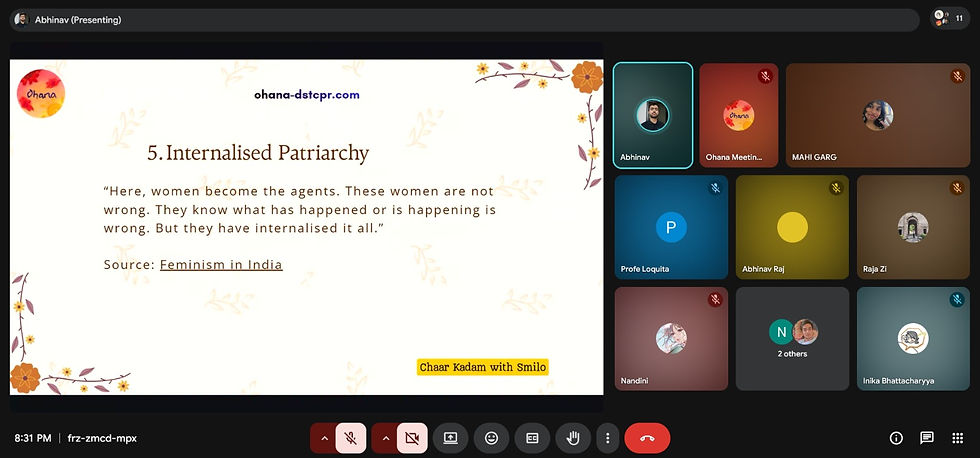
Further, Abhinav Raj added his observations regarding the same; he underscored differences between the discussions of the women working in a heated kitchen and those of men in the living rooms with a cooler — the former being grounded in existential realities and the latter merely phatic with little or no direct relevance to everyday life. In addition to this, he stressed on how women get “unlikeable” when they start protesting against their oppression. Abhinav also questioned Smilo’s thought process during the selection of the aesthetic theme of the presentation, which in his view was highly colourful and flowery. Kumar, too, stressed on the aesthetics part, which, according to him, reflected Smilo’s unconscious stereotyping of femininity and underscored that gendered roles and patriarchy are so ingrained within us that however hard we try to get rid of them, some traces always remain in our consciousness.
Offering a different perspective in this debate, Abhinav suggested a more biological reading and argued that femininity and masculinity lies in one's genomes which influence their everyday mannerism. Responding to it, Smilo stated that it is the milieu of a person which decides their gender, not their genes. Another participant with user name Raja Zi related the division of labour with the physical structures of males and females and argued that those anatomical differences are the reason why a particular job is assigned to one person and not the other. In this context, Kumar suggested that those differences should not translate into any kind of hierarchy or inferiority or superiority; also one cannot speak about the strengths and weaknesses of women using androcentric definitions and parameters.

Following this discussion, Mahi Garg, Raja Zi and Yashashwini Shukla shared some incidents from their lives which, according to them, were rooted in the social construction of gender. Finally, in the concluding part of the session, Kumar emphasised upon the need for redesigning the frameworks to tackle such issues and Smilo suggested considering the existence of gender, instead of being utterly gender-blind to better grasp the complexities of patriarchy.


Comments